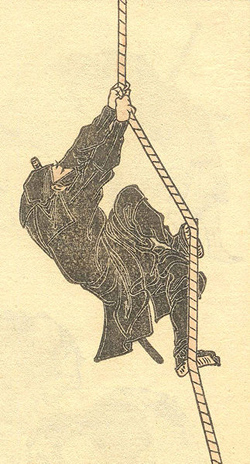
 Everyone knows ninjas were assassins in feudal Japan who wore special black outfits to hide themselves on night missions.
But apparently the word ‘ninja’ was rarely used in the past – the more usual term was ‘shinobi’.
And their outfits were actually dark blue and anything but special. They were typical farmers’ clothes, which the shinobi wore to blend into the crowd – and which admittedly came in handy when trying to avoid being noticed at night.
Plus they were much more than assassins – their activities included spying, sabotage, military combat, prophesy, astrology and code-making.
These were some of the facts I learned when I visited the Iga-ryu Ninja Museum in Japan. It’s a fascinating tour, including an original ninja house, full of trapdoors, revolving walls, secret passages and hidden compartments; a museum stuffed with ninja weapons, clothing and ingenious equipment; and a breathtaking demonstration of ninja combat skills.
I even got to wear some ninja chainmail and throw a shuriken (metal throwing star), although I couldn’t match the ninja who threw three of them at once, so that they embedded themselves in the wooden target in a neat row, a couple of inches apart.
And with my interest in memory systems, I couldn’t help noticing this explanation of the ninjas’ memory system:
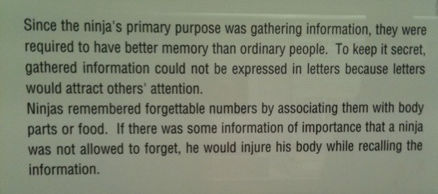
It sounds bizarre, but if you think about it, this approach makes perfect sense.
The mind works by association, so if you want to be confident of retrieving new information, the most reliable way is to attach it to something that you will definitely recall – and it’s hard to forget a part of your own body, or the pain of a wound!
Memory expert Tony Buzan likens this kind of technique to hanging a coat on a hook. You will always know where to find your coat (new information) if you hang it on an immovable hook (something you can remember easily).
The Ancient Romans used the same principle to develop the Roman Room memory technique, by first visualising a room and then adding an imaginary object to the room for each piece of information to be memorized.
For example, supposing your Roman room took the form of a comfortable living room and you wanted to remember to book a restaurant table for your anniversary. You might imagine your partner seated at a candle-lit table in the middle of the room, with a white-jacketed waiter standing by.
The incongruence of having the restaurant-table in your living room would help to make it memorable. And the visual details of the candles and waiter’s white jacket would also help to embed the memory.
Develop Your Ninja Memory Skills
If you want to improve your memory, you can take a leaf out of the ninjas’ book – but without inflicting so much pain on yourself!
1. Start with a single piece of information you want to train yourself to remember.
2. Consider the information and notice what associations it has for you – particularly any quirky, funny, sexy or otherwise memorable associations.
3. Pick one key association and exaggerate it so that it becomes comical, alarming, exciting or otherwise emotionally charged.
4. Visualise the exaggerated association and make sure it contains an extremely obvious clue to the information you want to recall.
5. Repeat the visualisation several times, hours and days apart, until you are certain it is permanently embedded in your memory.
For example, supposing you are learning Japanese and you want to remember one of the Japanese words for graveyard, ‘hakaba’. You consider the word and notice it sounds like ‘haka’, the war dance performed by the New Zealand All-Blacks before a rugby match, and ‘bar’.
So you imagine a bar set up in a Japanese graveyard, complete with shining taps for the beer, and several All Blacks players standing on top of it, performing the haka. The image is so bizarre that it’s unforgettable – especially when you realise with a grim smile that the black rugby kit is the perfect colour for a graveyard!
Or supposing you are trying to remember to prioritise work on a new portfolio website to showcase your work, but you keep finding yourself getting caught up in other people’s demands, and never seemed to find the time.
You visualise a traditional portfolio case, and imagine placing it on top of your to-do list, so that it blots out everything else on the list – reminding you to work on your portfolio first, before you get on with the rest of your day’s tasks.
So next time you’re struggling to remember something, look out for the ninja hovering in the corner of your eye, and remember to take his advice! 😉
Illustration: Drawing of a ninja by Hokusai.
Over to You
What would you most like to be able to remember?
What memory tricks do you use to remember important items?
Have you ever used a formal memory system?
About the Author: Mark McGuinness is a Coach for Artists, Creatives and Entrepreneurs. For tips on creativity, productivity and creative entrepreneurship, sign up for free updates from Lateral Action. And for bite-sized inspiration, follow Mark on Twitter here.


Excellent post, Mark. Loved the ninja story (and I now can remember the word: hakaba!). I have serious trouble remembering numbers (like my own phone number and how old I am…). I keep thinking I must go and have some hypnosis sessions to improve my memory, but your recommendations are definitely worth trying first. Being a visual person, the exercise looks like fun as well as being useful.
The book you want is Use Your Memory by Tony Buzan – he goes into a lot of detail about how to remember numbers.
As a hypnotherapist myself, I’d say hypnosis can help you with focus and visualisation, but you’ll get a lot more out of it if you read Buzan’s work first – the principles he teaches are the bedrock of developing a powerful memory.
This is such a cool post! I love stuff like this. I remember when I was younger picking up a book in a store that promised to teach you 10 spanish words in 10 minutes. Now I’m the worlds worst at learning languages, but I was shocked when this system actually worked! It was the same as you described in your post – you make a visual representation of the word in your head, picture it solidly for a minute, then it just seems to come back to you. I vividly remember that the first two words were ‘rice’ and ‘cow’. The book said to picture arrows being shot into a bowl of rice (the spanish word is arroz) and a cow with a frilly maids outfit on vacuming it’s field (the spanish word is vaca).
Later when I realized how well it had worked I went to order the book online … but I’d forgotten what it was called! Now that’s irony 😉
Ha ha, the irony. 🙂 Great example, now I know two words of Spanish!
Great article once again, love the original approach and i know it is not ninja like but i`ve bookmarked the article!
I think bookmarks are a great example of why we don’t need to remember everything.
I would most like to be able to remember NAMES. I’m terrible with them.
I am introduced to someone, and within a minute or so “poof” – it’s gone.
So if I’m at a social gathering where there are a lot of people I’m being introduced to, I can easily slip into a panic – and I will spend most of my time not socializing and networking, but trying to remember names.
So I most definitely am going to use some of these techniques, Mark. Thanks!
This works really well with names – the trick is to remember to do it instantly, when you meet them. Tony Buzan talks about using a similar approach to remember names in Use Your Memory.
Mark:
What I like best about the memory technique you write about here is that it’s versatile enough to apply to very different kinds of things we need to remember – from word meanings to tasks to prioritize.
One technique I learned in college makes use of association as well. Suppose you’re getting out of your car to go into a store, and there’s something in your car you want to remember to take out of there when you return. Applying the technique, you would take a moment, at the time you’re getting out of your car, to conjure the image of yourself coming back to your car and taking out the thing you want to remember to take out. This works well, because later, when we really do come back to the car, our brain remembers our image.
On a completely different note, I suspected that drinking wine was impeding my memory, so I did an experiment – no wine for 30 days. I noticed a huge improvement (among other good things). Toward the end of the 30 days, I didn’t even miss the wine. So I didn’t resume. That was over 6 months ago. The mental clarity that’s come with it feels really good, as does the improved sleep, which works wonders for just about everything.
Nice post (as usual).
Susan
The car technique sounds a good one. You can do it with physical objects as well – e.g. leaving something by the front door to remind you to do a particular errand when you’re out.
As for giving up wine, I think I’d have to be VERY motivated to remember something before I considered that! 🙂
The techniques mentioned can be effective and they demonstrate that good memory, like many other things in life, takes hard work. There are, though, three things you never forget: your mother’s name and your birthday.
Three things or two things? 😉
I presume that was the joke. 🙂
I must have been a bit slow that day! Was going to say the third could be your mother’s birthday. 🙂
Thanks for sharing knowlegde with us! It’s really interesting, now I want to go to this museum too!
Well worth the trip. Ueno, the town with the museum, also has the birthplace and home of Basho, the haiku poet, plus a Samurai castle. And an amazing beef restaurant! Highly recommended.
Hi
Reminds me of an old fashioned way for grand-grand pa’s to give their land to their grand sons.
For each portion of each child the grand-pa would go around the land with the kid and slap him very hard on each boundary stone, so the kid will always remember the limits of his heritaged land. Hard but that worked in my family for a while.
Also, it’s easier to remember things that matter to you, sometimes forgetting is a good indicator on what’s good for you and what’s drifting you away from your true goals.
Cheers
“And you tell that to young people today, and they won’t believe you.” 🙂
Seriously – great example, I’d never heard of that but it makes perfect (if painful) sense.
Indeed.
Mark:
If you’re interested in memory systems, you may Joshua Foer’s book “Moonwalking With Einstein”. Foer not only researched memory techniques developed by the ancient Greeks, but after a year of training with an English memory coach he won a significant international memory competition. Here’s a link to a review in the New York Times: http://www.nytimes.com/2011/03/08/books/08book.html
I have tried the mnemonics you described in an attempt to get over my terrible memory for names. Sadly, I never had any luck. I would remember only the ridiculous image and not the name it was meant to represent. But it did leave me with something interesting to think about whenever I saw the people whose names I was hoping to remember.
Cheers,
Bob
Thanks Bob, great example!
Re remembering names – Buzan’s book Use Your Memory might be helpful, it has more detailed advice. For me, the trick is to make sure the ridiculous image has a really obvious clue to the name – so absurdly obvious it’s hard to miss!
Another approach is to imagine you’re playing charades – how could you mime the name so that it would be impossible for the audience not to guess it?