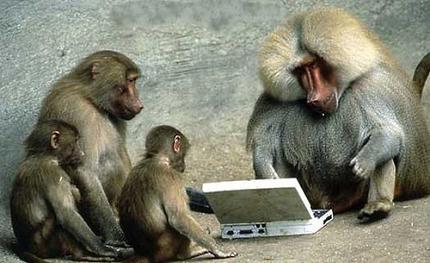
Photo by ChrisL AK
There’s an old saying that “the pen’s lighter than the spade”.
Back when going to school was a novelty for families used to toiling on the land, adults said it to children, to encourage them to study hard and make a better (and easier) life for themselves.
These days, you don’t even need to lift a pen. OK, a computer’s heavier than a pen, but you don’t need to lift it to work with it. You just need to glide your hands over the keys.
You hardly need to lift a finger.
So if you’re just sitting there all day, it makes no difference whether you’re in shape or not. Right?
Oh sure, if you consider the health implications, then of course you should be doing some kind of exercise, for your own benefit. But day to day, as an information worker in the creative economy, it won’t make any difference to the quality of your actual work. Right?
Wrong.
In his book Brain Rules, molecular biologist John Medina reports on a research investigation into the effects of exercise on cognitive performance, using a sample of 10,000 British civil servants between the age of 35 and 55. The researchers categorised the civil servants’ physical activity as low, medium or high, depending on their exercise habits.
Those with low levels of physical activity were more likely to have poor cognitive performance. Fluid intelligence, the type that requires improvisatory problem-solving skills, was particularly hurt by sedentary lifestyle.
(John Medina, Brain Rules)
So let’s suppose that you’re engaged in a creative profession, where ‘improvisatory problem-solving skills’ are critical to your economic success – but you’re too busy working (or too plain lazy) to take any exercise beyond a trip to the coffee machine. According to the research, with every day that goes by, you’re becoming less and less creative – and less and less competitive.
Are you still sitting comfortably?
Why Your Brain Needs Exercise
Medina points out that the human brain did not evolve in an environment remotely like the modern workplace. Our ancestors had to negotiate rainforests, deserts, mountains, plains and icy wastelands – all the while catching enough to eat without being eaten ourselves.
our evolutionary ancestors were used to walking up to 12 miles per day. This means that our brains are supported for most of our evolutionary history by Olympic-caliber bodies. We were not used to sitting in a classroom for 8 hours at a stretch. We were not used to sitting in a cubicle for 8 hours at a stretch. If we sat around the Serengeti for eight hours – heck, for 8 minutes – we were usually somebody’s lunch.
(John Medina, Brain Rules)
Since the brain evolved inside such active bodies, Medina argues, it makes sense to assume that it works best under conditions of high physical activity. This assumption is confirmed by biologists:
exercise gets blood to your brain, bringing it glucose for energy and oxygen to soak up the toxic electrons that are left over. It also stimulates the protein that keeps neurons connecting.
(John Medina, Brain Rules)
It’s starting to look like exercise, for knowledge workers, is a no-brainer.
How Much Exercise Should You Be Doing?
If you’re a marathon runner or gym bunny, give yourself a pat on the back and carry on.
But what if you’re more Jenny Craig than Daniel Craig? Do you have to commit yourself to a bone-crushing physical regimen, or does the research offer any crumb of comfort?
Actually, the findings could be a lot worse for the exercise-averse. According to Medina, “even couch potatoes who fidget show increased benefit over those who do not fidget”! You’ve probably guessed that it will take more than fidgeting to get yourself into a state of top mental performance. But it’s less than a marathon:
In the laboratory, the gold standard appears to be aerobic exercise, 30 minutes of play, two or three times a week. Add a strengthening regimen and you get even more cognitive benefit.
(John Medina, Brain Rules)
There, that’s not too bad is it?
And if you’re prepared to entertain one of Medina’s off-the-wall ideas, you may not even need to leave the office. He’s actually installed a treadmill in his own office, and a special stand so that he can type on his laptop while he walks.
“Treadmills in classrooms and cubicles” might sound like the ravings of a mad scientist – but the scientific evidence backs him up.
As another old saying goes, it’s crazy but it just might work.
Are You Sitting (Too) Comfortably?
Have you noticed any effect on the quality of your thinking from exercise – or the lack of it?
Exercisers – how do you prioritise workouts when there are so many other demands on your time?
What other creative ideas can you think of, for integrating exercise into the workplace?
About the Author: Mark McGuinness is a poet and creative coach.

Oh Dear, one of the ‘benefits’ of having only the lousy local CBC TV to ‘watch’ here in Barbados is being nagged by the advertorials for get fit DVDs; I’ve been thinking about this very thing so much lately – could it be time to stop thinking and get up and get moving? Don’t answer that! I’m going already.
I’m not saying anything. 😉
i’ve always felt more alert when performing physical activities … so it makes sense for me .
i knew that , at least in my case , physical activities made me a better person at everything …
and if the pay wasn’t so lousy i would give up the computer without a moment’s pause and start working on a construction site …
but i’m skinny and i have no real physical strength … so i don’t think they will take me … who knows , maybe that’s just the reason i think i would be willing to work on a construction site …
great article 😀
It’s true. Although recent evidence shows that exercise is not really linked to weight loss (you have to eat less and better for that), I know that after a good workout I can tear through mental work like writing, decision-making, and general cognitive performance. It gives me better focus and I don’t even notice when I start to do the “hard” tasks. I just jump right into them. Sadly even this yet isn’t enough to get me to the gym more than twice a week yet!
Even though I blog, I exercise everyday! AND I just took up muay thai kickboxing, so that should be fun.
Then again, this shouldn’t be too surprising since my blog is about raw food and fitness. 😉
Love all your articles, btw. Keep ’em coming.
Glad I found this article before needing two chairs. I may have to revoke my lardassian citizenship.
I’m going to post a link to this article on my blog.
i think it has a lot to do with your metabolism ( the weight loss thing ) .
a clear example is … oh well , me . i eat like there is no tomorrow ( 3-4 solid meals a day with various extra’s in between meals ) , i don’t exercise ( except 3-4 long walks a week with my dog in the park ) and yet i have never got over the 65kg threshold . i do smoke a lot , but i have been like this my entire life , not just in the past 6 years .
now granted , my metabolism is a little extreme ( i did a lot of visits at various doctors and they found nothing wrong with me ) but ultimately some of us gain fat faster and easier than others .
and those that do need to keep a very strict eye on what they eat and how they live .
Only twice in the last 45 years have I slipped out of the habit of frequent and rigorous exercise for more than a week or two. Unfortunately, now is one of those times. The danger of lingering in this situation too long is that you forget how much better and alive you feel when you are exercising. Thanks for the kick in the butt.
I was doing pretty well with walking and weights – until the ugly/muggy part of summer hit. Now there’s no air and I feel lousy much of the time. Is it September yet?
I can’t see how walking on a treadmill will do anything for creativity.
It’s more likely that being outside and having to think about things quickly would aid improvisatory problem-solving skills rather than being in a grey room with strip lighting walking to nowhere.
If you’re truly creative, you’ll already have found something to do to keep you moving; walking in a line on a conveyor belt isn’t it.
Thanks for the feedback everyone.
@Zhenya – Creativity moves in mysterious ways, so nothing works for everyone. Fresh air is probably ideal, but my experience is that even exercising in the gym clears my mind and sharpens my thinking.
Now if you’ll excuse me I must go to the gym… 😉
If we sat around the Serengeti for eight hours – heck, for 8 minutes – we were usually somebody’s lunch.
While I totally agree that sitting all day is highly unnatural, and that fitness is important for cognitive and creative work, I disagree totally with Medina’s claim that individuals in tribal societies could not sit around for 8 minutes without being “somebody’s lunch.” There is a large body of evidence that shows that the life of a tribal hunter and gatherer was full of leisure, with lots of sitting around (or rather squatting around), and only about 2-4 hours of work a day.
I’d also argue that walking 12 miles a day only takes 4-6 hours, hardly that of an Olympic athlete. We do not need to be anywhere near Olympic-level extreme fitness to function optimally, either in a tribal society or in a cubicle. Too much of a good thing can be very bad indeed. Far too many people overtrain, causing injuries and illness in the pursuit of maximum fitness.
This is an important fact, for we tend to interpret pre-historical tribal societies through our own lens of anxiety and fear of the natural world. Not only is it unnatural to sit 8 hours a day, it’s unnatural to *work* 8 hours a day. If we were truly to try and return to authentic, natural prehistorical existence, we should aim to only work 2 or 3 hours a day too–but of course, that is very unlikely.
That said, human beings are highly adaptable, and the quest to find our “natural state” is a simulacrum–an illusion with no original. Human beings have been continuously evolving and changing. The key is not to freeze some previous authentic state in a romanticized past, but to find what works today, given our existing and changing contexts.
I would take Medina’s moderate exercise recommendation as a minimum, but be wary of too much exercise (something rarely noted but often engaged in), and emphasize finding one’s own personal optimum balance.
Am I the only one old enough to remember the old Fox TV campaign from the 80s, “Be in it today, Live more of your life.” I loved that little ad campaign and was delighted to see one that encouraged people to walk AWAY from their television sets. I mean, how refreshing!
As it is, I know I don’t get enough exercise, but I do try to get my dog out for a walk every day, weather permitting … and, does knitting while watching television count as fidgeting? (grin)
@ Duff – Incisive points as usual. Maybe Medina is guilty of a little poetic licence, but I don’ think it invalidates his central argument that (a) our ancestors were a lot more active than the average cube-dweller and (b) there’s a lot of scientific and experiential evidence that exercise improvse mental performance as well as physical wellbeing.
And you’ll be pleased to know I take your warning about excessive exercise to heart. 🙂
@ Deb – I’m old enough but not American enough. 🙂 In the UK we used to have a kid’s show that opened with a song that went “Why don’t you just turn off your television set and go and do something less boring instead”, which I thought was pretty cool for a TV show.
It’s good to know there is research to support what I have found out since leaving the corporate world a year ago and writing full time. Exercise is more important than ever and often necessary to stimulate creative thought!
The treadmill desks go for about $4k a pop. Not a bad idea, if you’re going to be stapled to a desk, and can afford it.
I’ve set up a regimen that breaks up the day, and periodically stimulates my brain, and doesn’t require quite that much of a monetary investment:
Pick a sequence of exercises that can be done in about 5 minutes, and that doesn’t get you too sweaty. I use a kettlebell to do about 10-20 reps (but a dumbbell works fine), a jumprope to skip rope about 100 skips, then head out the door to walk around the block. But any combo of large body movements, with a walking cooldown will work.
Do this as soon as you get to work, then before lunch, after lunch, mid-PM, and before heading home for dinner. M/W/F, or T/R/Sat.
Investing in exercise equippage. Get a pedometer and work up to 10,000 steps daily. A walk around the block will yield about 1000 steps, and it’s addictive checking your pedometer and seeing how you can sneak in some more numbers.
Hey, I thought this was a nice article. Thank you for posting.