Business is rewarding itself to death, according to Dan Pink.
He’s not just talking about ‘fat cat’ pay and bonuses. He’s talking about something much more pervasive – and more destructive.
In this recent TED Talk, Pink questions one of the fundamental assumptions underlying the way most businesses are managed. Here it is in a nutshell:
Performance can be improved by offering rewards for good performance and penalties for bad performance.
Or to put it another way, the carrot and the stick are a manager’s best friends.
It sounds like common sense, doesn’t it? But it’s not true. Except in certain limited circumstances:
‘If… then’ rewards work really well for those sorts of tasks where there’s a simple set of rules and a clear destination to go to.
(Dan Pink TED Talk)
But for more complex, challenging tasks requiring creative solutions, it’s a very different story:
the rules are mystifying, the solution, if it exists, is surprising and not obvious – [for this kind of problem] those ‘If… then’ rewards, the things around which we have build so many of our businesses, DON’T WORK!
This is not a feeling… this is not a philosophy… this is a FACT!
(Dan Pink TED Talk)
In research, offering rewards for success in creative tasks has been proven to damage performance, over and over again. As Pink says in his talk, this is one of the most robust findings in social science. And to judge from the way most businesses are run, one of the most widely ignored.
Pink’s talk was brought to my attention by Sofia and Marelisa (who has written a great post about it herself) in the comments on last week’s article about Johnny Depp. That was the latest of several articles and an e-book in which I’ve explored the effect of extrinsic motivations (rewards) and intrinsic motivations (satisfaction in the work itself) on creativity.
By looking at such diverse talents as a Hollywood star (Depp), a choreographer (Twyla Tharp), a Victorian novelist (Anthony Trollope) and a 21st century marketer (Seth Godin), we have seen how creative excellence comes from pushing rewards to the back of the mind and focusing on intrinsic motivations – such as challenge, learning, flow and purpose.
My e-book on motivation and creativity draws on the research of Theresa Amabile, an expert in organisational creativity who has shown through her research that offering rewards or punishments can be a creativity killer. Her findings are summed up in what she calls the ‘intrinsic motivation principle’:
People will be most creative when they feel motivated primarily the the interest, satisfaction, and challenge of the work itself – not by external pressures.
(Theresa Amabile, ‘How to Kill Creativity’, Harvard Business Review, September – October 1998)
In his TED talk Pink focuses on research evidence from economists and social scientists, but he reaches exactly the same conclusion about the problems of extrinsic motivation:
In eight of the nine tasks we we examined across the three experiments, higher incentives led to worse performance.
(D. Ariely, U. Gneezy, G. Lowenstein, & N. Mazar, Federal Reserve Bank of Boston)We find that financial incentives… can result in a negative impact on overall performance.
(Dr. Bernd Irlenbusch, London School of Economics)(Both quotations taken from Dan Pink’s TED Talk)
… and finds the same solution:
It’s an approach built much more around intrinsic motivation, around the desire to do things because they matter, because we like it, because they’re interesting, because they’re part of something important.
(Dan Pink, TED Talk)
Why Motivation Matters in the Creative Economy
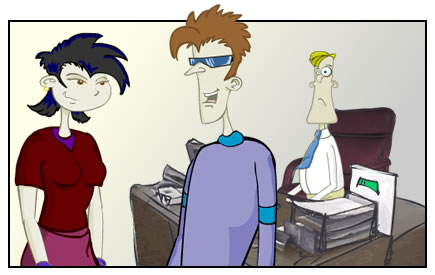
If you recall the first article published on Lateral Action (also inspired by Dan Pink) we looked at Why Creativity Is Economic Priority Number One.
The Rise of the Creative Economy means that someone like Lou, whose career plan is based on rewards, hierarchy and ‘cranking widgets’-style productivity, is in deep trouble. The more straightforward the task, the more likely it is to be automated or outsourced overseas.
Offering rewards works pretty well to raise the performance of people like Lou – but in advanced economies, they are becoming an endangered species.
Jack, on the other hand, is primarily motivated by the thrill of discovery and invention. When he decided to quit and set up his own business, his boss couldn’t persuade him to stay, even with the offer of a bigger paycheck and desk.
In the creative economy, companies and countries depend on people like Jack and Marla to dream up solutions to complex creative problems. And the hard evidence of the scientists and economists is that rewards don’t work for this kind of work.
Unfortunately, as Pink says – most companies are apparently ignorant of this fact, and continue to try to ‘motivate people’ with the carrot and stick.
When you consider the economic challenges we’re all facing right now, it’s not an overstatement to say that business is in danger of rewarding itself to death.
Three Keys to Creative Excellence
Dan Pink describes three types of intrinsic motivation that help companies and individuals to improve creative performance:
Autonomy – The urge to direct our own lives.
Mastery – The desire to get better and better at something that matters.
Purpose – The yearning to do what we do in the service of something larger than ourselves.
(Dan Pink TED Talk)
The bad news is that if your company is based on controlling people and has no greater purpose than making money, you’re going to have a tough time competing with organisations that unlock creative talent by inspiring people with a sense of purpose and empowering them to become masters of their chosen field.
The good news is that you don’t have to be a big company to use Pink’s three keys – you can start to do it right now, in your own life. Let’s take autonomy as an example:
How much creative freedom does your current work afford you? If the answer is “a lot”, then make the most of it. If “not much” then you can either push for more autonomy at work – or set up a side project in your spare time, that gives you the opportunity to use your talents to the full. You never know where it might lead you.
Set aside time to try things out for fun and curiosity. Play around with your paints or guitar. Start a blog. Make a video. Go to a meetup without your business cards – just to hang out and enjoy the conversation.
It may feel like you’re goofing off and wasting your time. But the science suggests otherwise.
What Motivates You?
What do you make of the research findings that offering rewards can harm performance?
How important are autonomy, mastery and purpose to you in your work?
Can you think of examples of successful companies driven by intrinsic motivations?
About the Author: Mark McGuinness is a poet and creative coach.

Rewards are used in many arenas and they play out much the same. Thanks for a thoughtful and in-depth analysis of a pervasive problem. Rewards may work well initially out of novelty, since the brain is stimulated by novelty, but it soon wears off that is where problems with this arise.
I love this article because it shows the weaknesses in big money corporations and proves that people like you and I, with our dreams and our big ideas, will prevail over old mentalities.
Of course, they’ll argue all the way to the grave…but that’s their problem 🙂
Pieces of silver and whiplashes from the widget producing world does not work in the creative economy; but creative efforts can still be inspired by actual ownership in the finished product. Various mechanisms on royalties, profit-sharing and commissions provide material motivation – aligned perfectly with the three keys described by Dan Pink.
Check out the work by Alfie Kohn. I think you will love it. “Punished by Rewards” is a classic in educational literature, his other books are also paradigm shifting works.
It is not surprising that businesses use behaviorist models. Most educational practices are based in the behaviorist paradigm you described in your blog post. “A’s” and “F’s” and stars and detention are the philosophy of good discipline and drilled in our heads as the best and only way. In Special Education there are people who use Fruit Loops and “good boy” for positive rewards, and everything from electric shock, cattle prods and “time out” on children who don’t do as the adults want–all in the name of conformity and discipline. Some even argue this is a biblical mandate.
Unfortunately, the people who believe in controlling, punishing and strict “behavioral” paradigms and approaches greatly outnumber the people who believe in constructivist, inquiry, creative and motivational learning.
I’m hoping your post reaches many people and help give food for thought. Much more effective than fruit loops.
Hi Mark: Thank you for mentioning my blog post. What you say at the end reminds me of another Dan Pink video I watched on YouTube where he argues that if you’re in an organization which doesn’t encourage creativity, that you should pick a project and do something amazing with it anyway. You might be pleasantly surprised to discover that you get praised for taking a creative initiative. If, instead, you’re scolded for “stepping out of line”, then you know you need to leaven as soon as you can.
Businesses aren’t run to make money. They’re run to satisfy the urges of their proprietors. They have to make a little money to survive but from what I’ve seen over the years their principal function is to create an environment in which the proprietor can press the button in their head which gives them the most buzz. That’s the point of the exercise, not making money. It means their often anti-social behaviour can be justified as socially acceptable (and even laudable) so they get praised for acting infantile. It’s a forebrain excuse for hindbrain behaviour, self-gratification masquerading as industry. This is why economic models don’t work, they’re all built around the concept of business-owners acting in a rational fashion and the basis of their actions is money-making. They do act rationally but the basis is self-gratification and making money will often be discarded in pursuit of that aim. Did I just wipe out the science of economics? You betcha!
BB
@ Robyn – Thanks for the in
@ Nathan – When we rule the world… 😉
@ Gagan –
Interesting point. I’m not sure it’s 100% aligned with Pink’s keys, but maybe not far off – autonomy yes, mastery maybe, purpose – yes, depending on the nature of the commission.
I’ve seen some other research about the effect of commissions on artists’ work – after analysing some commissioned v non-commissioned work, an expert panel judged the non-commissioned work to be the best. But with the exception of those commissions that enabled the artist to “do something interesting or exciting”, which were judged the best of all. They concluded that in these cases there was an optimum balance between intrinsic and extrinsic motivations.
@ Mary – The Kohn book does look good, thanks for the recommendation.
Fortunately it’s the other way round among Lateral Action readers. 🙂
@ Marelisa – Thanks, that’s a good acid test! Looking back I think I applied it once or twice without thinking of it like that.
@ Kruse – Robert Twigger writes a very funny account of corporate life, where he says all the work has to be done in the evenings and early morning, because “working hours are for power displays”.
Mark,
if Michael E. Gerber who wrote the E-Myth saw Dan pink’s talk he would argue that businesses need to turn their messy functions into standard processes that don’t need creativity.
It’s interesting that the new crop of online “encyclopedias” that are coming out are using paid incentives to beat Wikipedia. I wonder if any of them will work.
Hashim – That’s the one part of the E-Myth that didn’t do it for me. 🙂
‘Beating Wikipedia’ sounds a bit futile to me. ‘Doing something radically different – and valuable’ – now that would be interesting…
Mark – that part of the E-Myth doesn’t do it for me either!
Thanks for introducing me to Pink’s work. I thumbed through one of his books yesterday, and I plan to buy one of them today.
Was the research really needed?
How could an incentive motivate someone to DO better when the task isn’t about doing?… a cognitive task, like being creative, is a BEING task… it’s on or off, it’s not mechanical and therefore can’t be practiced.
People claim you can teach creativity… well show me the college class. Sure, you can make generalizations, get more sleep, be healthier, but creativity is basically just daydreaming with intention.
The research just verifies for me that BEING tasks are motivated by being-related rewards (existential) … certainty, ego, personal satisfaction, and DOING tasks (conventional) can be motivated by conventional rewards… if I get three tasks done on my break instead of two then I can go play basketball.
This can be a ideal blog for anyone who wants to discover more on this topic. You realize a lot its almost very difficult to argue with you (not that I truly would likely want…HaHa). You certainly put a brand new spin on the topic that’s really been discussed for decades. Great stuff, just simply fantastic!
I constantly spent my half an hour to read this weblog’s articles every day
along with a cup of coffee.
These online play angry birds can basically be played online and are additive and fun game.
A rectangular shaped metallic design is attached at the center which is studded with glittering
white and red stones. Really feel the race once you dive down and free riders birds and pigs
with dizzying velocity – with many lifeless-ends and corners of this monitor suffocation.
As you get ready your self for self-hypnosis training in your own house, get ready to
find 1 of the most soothing methods to make positive
alterations. Change to a brand of cigarette you don’t normally smoke, that you don’t really
like. With feminization self hypnosis it is guaranteed that
you will feel, act and behave totally according to your feminine side;
that is already there just waiting to be realised and experienced in its most beautiful and glorious way.