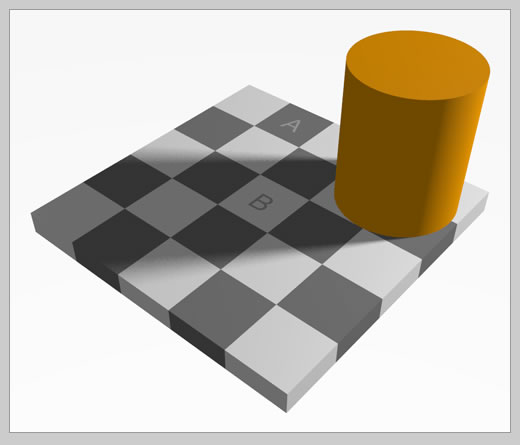
Have a look at the picture below and answer this simple question:
Which square is darker – A or B?
(Don’t scroll down and read the text until you’ve answered the question.)
Easy huh?
That’s right – the correct answer is ‘neither’. Squares A and B are exactly the same colour and shade.
Don’t believe me? I must admit I was sceptical myself. Have a look at this next image – which blanks out the rest of the picture, except squares A and B and the edges of the squares next to them:
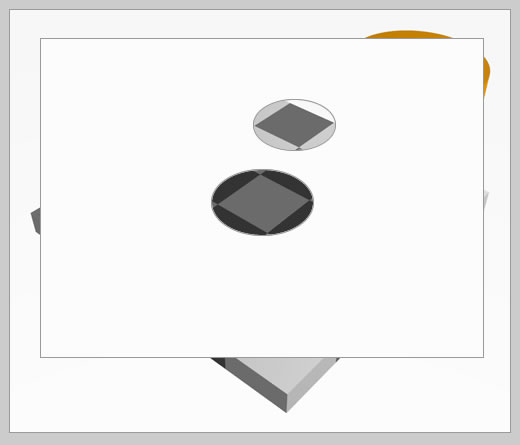
If you’re still not convinced, you can print out the image and fold or cut the paper so that you can see squares A and B side-by-side.
They say seeing is believing. But after looking at this image many times I’m not so sure.
The first time I saw it, I was convinced the two squares were completely different shades. That’s why I asked Tony Clark – our resident graphics wizard – to create the animations. Now I trust Tony implicitly, but when I saw this I was convinced the squares changed colour in the second frame. So I asked him as tactfully as I could whether he hadn’t messed with the squares. Here’s his reply:
I was the one doing it and still was fooled. The proof was that in Photoshop I used the same exact color to shade out the “A” and “B” – so it really is the same color 🙂
How can an illusion be so powerful that it even fools the person creating it? Because of the way our brains are wired – we’ve evolved to notice differences (such as a movement among motionless trees) and to be highly sensitive to context (such as the shades of adjacent squares). These abilities are so important to survival that it’s almost impossible to override them. Which means the squares still look different even when we ‘logically’ know they are the same.
What Does This Have To Do with Creativity?
Remember the spinning lady? Which way did she spin for you? What did you conclude from that?
I was fascinated by the comments on Brian’s post, as they mirrored my own responses when I first saw the spinning lady. Like most people I saw her spinning counter-clockwise at first – which, according to the conventional explanation means I’m more left brained and logical than right brained and creative. How do you think that made the poet/creative coach feel?
Reading through the comments I recognized my own mixed thoughts when I first saw the illusion. Some people were convinced it was going one way, some were certain it was going the other. Some said it was clearly going one way then changing direction. Some said it was obviously a hoax. Some were pleased because it confirmed their image of themselves as left or right brained. Some were disappointed that it meant they weren’t ‘creative’ enough.
Can you see how black-and-white this kind of thinking is? As soon as we see the image, we want to put it – and ourselves – into a mental category as quickly as possible. Clockwise or counter-clockwise? Left brain or right brain? Logical or creative? Real or hoax? We feel uncomfortable with ambiguity, shades of grey and subtle distinctions.
Hardly any of the commenters responded to Brian’s assertion that “your left brain plays a crucial role in creativity as well”, and his questioning of the conventional wisdom about brain hemispheres and creativity:
Weigh in with your opinion about the right brain versus left brain for creativity… isn’t it really a “whole mind” thing?
The ‘whole mind’ concept of creativity is like the true appearance of the two squares on the chessboard: it’s staring us in the face but we can’t see it because of the black-and-white shades competing for our attention.
From Illusions to Reality
But these are just illusions, a bit of harmless fun – right? Well see what you make of these examples of real-life black-and-white thinking:
This ‘telephone’ has too many shortcomings to be seriously considered as a means of communication.
Western Union internal memoDrill for oil? You mean drill into the ground to try and find oil? You’re crazy.
Drillers whom Edwin Drake tried to engage in his enterprise to make money from drilling for oilLouis Pasteur’s theory of germs is ridiculous fiction
Pierre Pachet, professor of Physiology at Toulouse, 1872What would I do? I’d shut it down and give the money back to the shareholders.
Michael Dell on Apple ten years agoWho the hell wants to hear actors talk?
H. M. Warner, Warner Brothers, 1927We don’t like their sound, and guitar music is on the way out.
Decca Recording Co. rejecting the Beatles, 1962Stocks have reached what looks like a permanently high plateau.
Irving Fisher, professor of economics, Yale University, 1929DOS addresses only 1 megabyte of RAM because we cannot imagine any applications needing more.
Microsoft, 1980Windows NT addresses 2 GB of RAM which is more than any application will ever need.
Microsoft, a few years laterEverything that can be invented has been invented.
Charles H. Duell, Commissioner, U.S. Office of Patents, 1899
How about You?
What do you make of the chessboard illusion?
Have you ever got stuck in black-and-white thinking?
Have you ever broken out of it? What did you discover?
About the Author: Mark McGuinness is a poet and creative coach.

I’ll admit that I had to pull the screenshot into photoshop to verify. But not because I didn’t believe the illusion, but b/c the roll over graphic made me doubt it.
The spinning girl illusion was just that, an illusion. The “left brain/right brain” urban myth attached to it was debunked here: http://well.blogs.nytimes.com/2008/04/28/the-truth-about-the-spinning-dancer/
While it is an optical illusion, it’s not a ‘brain test’ – that part has been perpetuated by the internet.
See how easily we buy into something tho when we want to? Most of the quotes you have listed are also people who had a vested interest in not pursuing that which they dismissed… either because it created more work for them, or validated their competitors.
We do like to impose limits on our thinking – but sometimes, because it means we can also limit our own time investment. If there is “no need” then we do not have to pursue it.
But it is often the person who invests his time who finds the oil/silicon/invention gold. Then again – sometimes you get pets.com.
Still – brilliant article. Now going to assess what ‘black and white’ thinking I’m using to hold myself back. 🙂
~GeekMommy
And from reality right back to illusion. Duell never said that about inventions. See here for a refutation. http://www.myoutbox.net/posass.htm
Interestingly this exposes another bias we all suffer: The tendency to believe entertaining stories that support the point we’re trying to make, no matter how little sense they make if you think about them.
It took all three illustrations to make a believer out of me and the truth is, there is a part of my mind/brain that is still saying “it ain’t true.”
The idea that one side of the brain or the other is more creative depends on the definition of creativity doesn’t it?
I know typing is one of those skills that’s supposed to help “integrate” the two sides… my hunch is I’d be a total mess without both, probably incapable of doing much, at least not until I’d gotten some serious re-training.
Sure, the right side of my brain may spark those things I think are new ideas, but it’s the left that helps me sort out what works and what doesn’t.
Anyway, thanks… will link to this one for sure.
What a great article. Perhaps this is why conspiracy theories exist as well. Human nature always wants an explanation, although we might not believe what we are told we still seek an explanation as we need that closure of the ultimate answer.
The last article definitely wasn’t a brain trick as I mentioned in the comments there (and the first commenter here mentioned):
http://well.blogs.nytimes.com/2008/04/28/the-truth-about-the-spinning-dancer/
However, this one was quite amazing. I brought a few people from the office around the screen and they were all impressed.
Good work!
Cheers,
Glen
Wow Mark, this is really a brain twister! 😉
I took 10 Minutes just to compare those 2 squares – it’s funny how our brain sometimes tricks us.. 😉
Perceiption creates reality… but what if we look closer? Then sometimes the things beginn to shift.. to change…
It’s important to get out of the box of our thinking, to get out of the box thinking, because that is where real change can happen!
Thanks again and have an awesome day!
André
Nice! Ok, this one I like better. And not just because I figured it out.
To test it I added an element as a constant to compare against so as to compare squares out of their context. No, I did not resort to photoshop, instead I grabbed a post-it note and checked the edge contrast between it and each of the two squares, swiftly moving back and forth hovering over each of them simply comparing contrast with the post-it note [must move swiftly or eyes will adjust to either condition]. Realizing I couldn’t consistently tell which was darker or lighter, aka sometimes the black square looked lighter, I figured they must be the same. 😎
Ok, having spent years as an on location photog. lugging a 4×5 camera and a solid understanding of Ansel Adams zone system helped.
I went to an art school that taught me creativity was not confined to a medium, a gift, an outlet, it was a way of life. A way of perceiving and interacting with the world. Creativity has no bounds, certainly no right/left restrictions, its rather an approach to how to…solve an itch, whether that itch be how to express something one feels/thinks that needs to be said, how to express things better for others, or how to pay ones rent without a ‘normal’ job. Actually, that last one can bring out the most stunningly creative solutions at times.
But then I’m one of those geeks that likes ‘killer sudoku’, ever seen killer sudoku? There are no numbers defined when you start. Instead you start with shapes, and some info on each of those shapes. Aka this shape of three squares when summed totals 6, oh must be a 1,2 and 3. As for which goes where, well, the regular rules of sudoku do apply. You look at the other shapes and start deducing. Its a seriously full brained creative problem solving puzzle. If you try it, don’t blame me for the lost hours of sleep.
Oh, and if it sounds easy remember 3 squares = 6 is easy, with 3 squares = 12, the permutations…could be anything, (1,2,9 ; 3,4,5 ; 2,3,7 ; 1,5,6 ; 1,3,8 ; etc..) its totally context dependent on other things around it. Relevance? Simply that it requires full brain thinking, I’m fairly certain that neither the right nor left sphere in isolation could solve it.
But, I digress. Sorry.
Cool puzzle, nice illustration.
Bev
We are so caught up in political correctness and racist or not racist that we struggle with patriot vs a not patriot. To me it is about this country and not the government or black vs white. For those of you who want to keep loving Obama I say you are unfair. This guy Obama nothing good for America. Obama has caused more division than any previous leader. Obama is a proven liar, deceitful to truth, and the worst leader this country has ever had. We need to quit supporting low lifes over some ideology especially when it hurts all of us. Obama lovers and those who don’t support this alien. We are getting close to losing everything we as Americans ever believed in. This includes liberals and conservatives. Obama has made it a point to divide race, hard working, and honesty from all of us. Wake up folks …… please forget party loyalty for government. Be loyal to America and freedom.
What does it say of me that I just spent 20 minutes (not kidding) trying to figure out why you thought the *squares* were the same color?
“No, Mark… I’m pretty darned sure the A square is a dark grey and the B square is nearly white…”
I swear. I’ve had coffee. Really.
Hm. Funny I was going to comment but the things I know about right brain do not always come with easy words. Sometimes it is mere kinectics and intuition. It takes the left brain to do that narration and once words are put to something it changes the way we process them.
Really, studies show that children who do not know the names of colors process them in the right brain. Once they learn the names and categories of them, they process them in the left brain.
One of the real jobs of an artist is to leave that left brain process behind ( once it serves it’s purpose) and get to the non verbal, intuitive ” primitive” response brain.
So I think it is a whole brain process, just not always simultaneously. 😉
Great post and right on! Bev, your perspectives are brilliant and needed sorely in the world at this time. Everyone wants a magic bullet for creativity and innovation and yet it’s simply a matter of retraining our perspectives..
I blogged about it http://zenstorming.wordpress.com/2008/12/01/perceptions-creativity-illusion/
Robert Anton Wilson is my hero of breaking out of black-or-white dualistic thinking:
http://www.youtube.com/watch?v=LZBDUJ0yiVg
“All perception is gamble.” The optical illusion in this post was a fantastic example of that!
I also love the idea RAW talks about with a 3-valued logic. A statement can be true, false, or “maybe.” 🙂 It’s much harder to actually do, however! I thought “for sure” that the squares were different colors, even though I already knew the trick.
I love those quotations. It’s making me really think…
The spinning lady clearly spins clockwise for me. And it makes me happy to realize that it spins the other way for some people who are leaning towards rational thought processes.
I wonder if they are happy about it too. It would be interesting to do a survey to find out people’s reactions to taking this test. (Maybe it has already been done and I missed it. Always possible).
I’m thinking some of them won’t be happy with this outcome. It’s too “weird”. LOL.
“All perception is gamble.” I love it, Duff! Thanks for the link!
Jeannette
The wonders of education, creative thinking, and the brain. I am still having a hard time believing the squares are the same color. Your post reminds me of a debate I used to have with my father years ago. It was something to the extend of:
“What color is the sky?”
“It’s blue!”
“How do you know?”
“What do you mean, how do I know? It’s blue.”
“What if blue is really red? And the #1 is really the #12? Maybe your whole life someone told you the opposite of what is.”
That might be a bit more in depth than the color of the boxes analysis, but I can definitely see the same thought pattern. Our brains play some interesting tricks on us. Sometimes it’s good to make a clear distinction between black and white…but gray can be just as interesting, too!
The spinning lady allusion dictated I am a creative. And so I loved the teal and tangerine chessboard!
But I was fooled. Naughty brain. Naughty!
It’s a fascinating optical illusion. To double check, I copied the graphic into Photoshop and used the dropper to verify the RGB values were the same, they are.
As to that whole right-brain, left-brain hypothesis…hasn’t it been disproved time and again. It’s far too convenient and far too easy to disprove with polymathematical people and those who have brain abnormalities
Thanks for the feedback everyone.
Michael P – ta for posting.
Duff – great video. ‘Naive realism’ – I’ll have to remember that one!
Robertbruce – “Naughty brain.” 🙂
You’ve raised some great questions lately. Often with blogging, irregardless of niche, we see more of the same. While I’m sure there are some undiscovered niche’s out there, what those of us who haven’t discovered them need to do is jump out of the mold and stop conforming to the same old thing.
I’m not 100% sure how to do that yet, but it is something I’m looking for.
Another great post ! Here’s another great black and white illusion:
Photo illusion
I think you kind of lost me. Are you trying to debunk the fact that these kinds of tests can be used to assess the whole “which side of the brain is your strongest” argument and saying that the “whole brain” is always involved? Hmmm…
That is a very interesting thing you did with the images. I still think there has to be some sort of manipulation there (although not in a nefarious way). I’m thinking the square that appears darker (and I may betray my total ineptitude with design here) is for all intents and purposes actually darker than the “B” square because it is being shaded by the darker squares around it. I’m not sure it’s just the eye’s perception.
Hi Chris — yes, we’re sceptical about the validity of such tests in assessing their legs left/right brain dominance. And also sceptical about the idea that the ‘right brain’ is the ‘creative’ side.
I think you’ve lost me about the square being “for all intents and purposes actually darker” — I’m no artist but if it’s a two-dimensional image how could it be “shaded by the dark squares around it” except in “just the eyes perception”? 🙂
This totally BLOWS MY MIND.
Are you *sure* you ain’t lyin’?
😉
This is fascinating … especially in image two, when I hover my mouse and the two squares are isolated, I could have sworn they go a darker shade as that happens! However, Photoshop allayed my doubt… great illustration and a nice article!
Amazing optical illusion that proves the brain works on relative not absolute principles. Geoff Dodd, Australia
This is so freaky! I can’t for the life of me see the difference in the 1st and the 2nd pic. Only in the 3rd pic am I convinced.
If seeing is believing, then can we even believe half the things we see?
Andy – some days I think 50% is being optimistic. 🙂
They do not have the same colour, but they appear to be the same because of the shadow.
If they’d have the same colour, square b in picture 3 would not be visible, because it would have the same colour as the squares sorounding it, which have the colour of square a.
What I looked at was the shadow cast by the cylinder as it split the black squares. The portion of square that the shadow fell upon was darker. At least to my naked eye. Are you saying the fact that the B square being white evens out the shadowing, so that neither is darker. B was, is darker. Just look at the black square split by cylinder.
@Stormgust, @Patrick – if you don’t believe us you can always print the image, cut out the squares and place them side by side!
I love these illusions. They are a powerful reminder of how any of us can get caught in either/or thinking.
Hello! This article has actually helped me chose a path to follow. Thanks so much for the great info and keep up the good work!
Thank you for so many and much information. It was fascinating to read. Thank you for sharing all these ideas with us and and keep up the good work.